

 Why Strut
 Services
 Recent Surveys
 Locations
 Knowledge
 Contact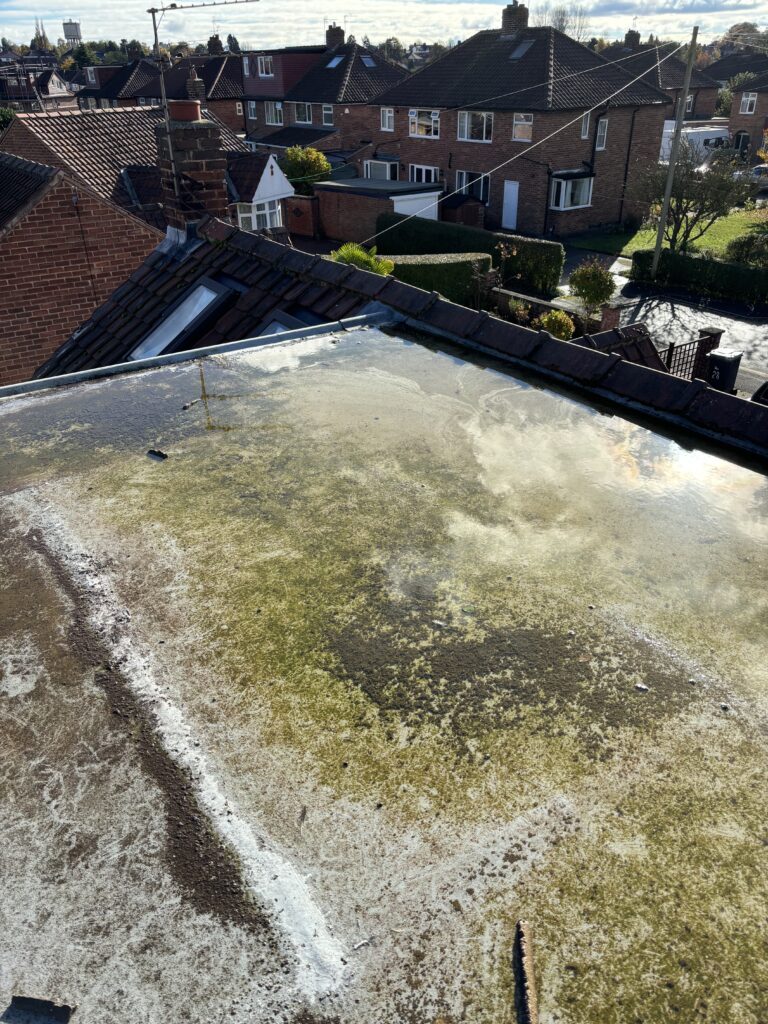
Flat Roof Defects in York – Surveyor Inspections of Failed Membranes
Flat roof defects in York are one of the most common reasons for persistent leaks, repeated repairs and premature roof replacement. Despite advances in materials and systems, many flat roofs fail far earlier than expected — often within 10–15 years of installation.
This guide explains how surveyors investigate flat roof defects in York, why membranes fail prematurely, and why inspection-led diagnosis is essential before repair or replacement decisions are made.
This article forms part of Strut’s 2026 inspection series on poor roofing work in York and builds on our guides to poor roof workmanship in York and leaking roofs in York.
Why Flat Roof Defects in York Are So Common
Flat roofs are unforgiving. Unlike pitched roofs, they rely entirely on correct design, detailing and installation to remain watertight. Small errors that may be tolerated on a pitched roof often result in failure on a flat roof.
In our inspections of flat roof defects in York, recurring underlying causes include:
- Inadequate falls leading to standing water.
- Moisture trapped within the roof build-up.
- Poor detailing at upstands, edges and penetrations.
- Incorrect insulation placement.
- Failure to follow system manufacturer guidance.
York’s climate — with regular rainfall, freeze-thaw cycles and seasonal temperature swings — further exposes weaknesses in flat roof construction.
Types of Flat Roof Systems Commonly Seen in York
Surveyors inspecting flat roof defects in York encounter a wide range of systems, each with its own failure modes.
Felt (Built-Up Bitumen) Roofs
Still common on older extensions and garages. Defects often arise from:
- Split or blistered layers.
- Failed laps.
- Inadequate edge detailing.
Single-Ply Membranes
Popular on commercial and modern residential buildings. Failures often relate to:
- Poor welding at seams.
- Incorrect mechanical fixing patterns.
- Insufficient ballast or restraint.
Liquid-Applied Systems
Frequently used for refurbishment. Common issues include:
- Inadequate substrate preparation.
- Incorrect thickness.
- Poor curing conditions.
Standing Water and Inadequate Falls
One of the most significant contributors to flat roof defects in York is standing water, also known as ponding.
Flat roofs should be designed with falls to direct water toward outlets. Where falls are insufficient or drainage is poorly located, water remains on the surface for prolonged periods.
Prolonged ponding accelerates membrane degradation, increases the risk of water ingress and places additional stress on joints and details.
Moisture Trapped Within the Roof Build-Up
In many cases of flat roof defects in York, water is not entering through a visible tear or hole, but is trapped within the roof structure.
Common causes include:
- Overlaying new membranes onto wet substrates.
- Failed vapour control layers.
- Incorrect warm-roof or cold-roof construction.
- Insulation installed without continuity.
Trapped moisture leads to blistering, loss of adhesion and hidden deterioration of the deck beneath.
Defective Detailing at Upstands and Penetrations
Surveyors investigating flat roof defects in York frequently find failures concentrated at details rather than open areas.
Typical problem areas include:
- Upstands around parapets and walls.
- Rooflight kerbs.
- Pipe penetrations.
- Edge trims and terminations.
These details require precise execution. Sealants are often used in place of proper mechanical or membrane detailing, leading to early failure.
British Standards and Flat Roof Compliance
Flat roof design and installation are governed by clear technical standards. Failures to comply are a recurring feature of flat roof defects in York.
- BS 6229 – Flat roofs with continuously supported coverings.
- BS 5250 – Control of condensation.
- Building Regulations Approved Documents.
- Manufacturer installation manuals.
Contractors such as Neal Roofing and Roof York demonstrate the importance of standards-led detailing rather than short-term fixes.
For an overview of regulatory requirements, see this guide to roofing regulations .
How Surveyors Inspect Flat Roof Defects in York
A surveyor-led inspection of flat roof defects in York follows a structured process.
Visual Assessment
Membrane condition, joints, outlets, edges and surface finishes are examined for signs of failure.
Internal Inspection
Ceilings and roof voids are checked for staining, condensation, deck deflection and insulation defects.
Contextual Analysis
The roof is assessed in relation to building use, internal humidity, heating patterns and recent alterations.
Repair, Overlay or Full Replacement?
One of the most common questions arising from flat roof defects in York is whether a roof can be repaired, overlaid or must be fully replaced.
Surveyors assess:
- Extent of moisture penetration.
- Condition of the deck.
- Remaining service life.
- Feasibility of compliant repair.
In many cases, repeated overlays simply trap moisture and accelerate failure.
When Flat Roof Defects Become a Dispute
Flat roof defects in York frequently lead to disputes where:
- Recently completed work fails.
- Defects appear shortly after installation.
- Warranties are challenged or rejected.
- Responsibility between trades is unclear.
Surveyor reports provide independent evidence of causation, workmanship quality and compliance.
Inspection Before Repair – The Key Message
The defining lesson from repeated cases of flat roof defects in York is that inspection must come before repair.
An inspection-led approach ensures:
- Accurate diagnosis.
- Appropriate remedial strategy.
- Reduced long-term cost.
- Clear accountability.
Next Steps – Booking a Flat Roof Inspection in York
If you suspect flat roof defects in York, the most effective first step is an independent inspection.
Strut Building Surveyors provide impartial, technically robust reports designed to diagnose cause rather than sell systems.
Flat Roof Defects in York – Surveyor Inspections of Failed Membranes
Flat roof defects in York are one of the most common reasons for persistent leaks,
repeated repairs and premature roof replacement. Despite advances in materials and systems,
many flat roofs fail far earlier than expected — often within 10–15 years of installation.
This guide explains how surveyors investigate flat roof defects in York,
why membranes fail prematurely, and why inspection-led diagnosis is essential before
repair or replacement decisions are made.
This article forms part of Strut’s 2026 inspection series on
poor roofing work in York and builds on our guides to
poor roof workmanship in York and
leaking roofs in York.
Why Flat Roof Defects in York Are So Common
Flat roofs are unforgiving. Unlike pitched roofs, they rely entirely on correct design,
detailing and installation to remain watertight. Small errors that may be tolerated on
a pitched roof often result in failure on a flat roof.
In our inspections of flat roof defects in York, recurring underlying causes include:
- Inadequate falls leading to standing water.
- Moisture trapped within the roof build-up.
- Poor detailing at upstands, edges and penetrations.
- Incorrect insulation placement.
- Failure to follow system manufacturer guidance.
York’s climate — with regular rainfall, freeze-thaw cycles and seasonal temperature swings —
further exposes weaknesses in flat roof construction.
Types of Flat Roof Systems Commonly Seen in York
Surveyors inspecting flat roof defects in York encounter a wide range of systems,
each with its own failure modes.
Felt (Built-Up Bitumen) Roofs
Still common on older extensions and garages. Defects often arise from:
- Split or blistered layers.
- Failed laps.
- Inadequate edge detailing.
Single-Ply Membranes
Popular on commercial and modern residential buildings. Failures often relate to:
- Poor welding at seams.
- Incorrect mechanical fixing patterns.
- Insufficient ballast or restraint.
Liquid-Applied Systems
Frequently used for refurbishment. Common issues include:
- Inadequate substrate preparation.
- Incorrect thickness.
- Poor curing conditions.
Standing Water and Inadequate Falls
One of the most significant contributors to flat roof defects in York
is standing water, also known as ponding.
Flat roofs should be designed with falls to direct water toward outlets.
Where falls are insufficient or drainage is poorly located, water remains
on the surface for prolonged periods.
Prolonged ponding accelerates membrane degradation, increases the risk of
water ingress and places additional stress on joints and details.
Moisture Trapped Within the Roof Build-Up
In many cases of flat roof defects in York, water is not entering
through a visible tear or hole, but is trapped within the roof structure.
Common causes include:
- Overlaying new membranes onto wet substrates.
- Failed vapour control layers.
- Incorrect warm-roof or cold-roof construction.
- Insulation installed without continuity.
Trapped moisture leads to blistering, loss of adhesion and hidden deterioration
of the deck beneath.
Defective Detailing at Upstands and Penetrations
Surveyors investigating flat roof defects in York
frequently find failures concentrated at details rather than open areas.
Typical problem areas include:
- Upstands around parapets and walls.
- Rooflight kerbs.
- Pipe penetrations.
- Edge trims and terminations.
These details require precise execution. Sealants are often used in place
of proper mechanical or membrane detailing, leading to early failure.
British Standards and Flat Roof Compliance
Flat roof design and installation are governed by clear technical standards.
Failures to comply are a recurring feature of flat roof defects in York.
- BS 6229 – Flat roofs with continuously supported coverings.
- BS 5250 – Control of condensation.
- Building Regulations Approved Documents.
- Manufacturer installation manuals.
Contractors such as
Neal Roofing and
Roof York
demonstrate the importance of standards-led detailing rather than short-term fixes.
For an overview of regulatory requirements, see
this guide to roofing regulations
.
How Surveyors Inspect Flat Roof Defects in York
A surveyor-led inspection of flat roof defects in York
follows a structured process.
Visual Assessment
Membrane condition, joints, outlets, edges and surface finishes are examined
for signs of failure.
Internal Inspection
Ceilings and roof voids are checked for staining, condensation,
deck deflection and insulation defects.
Contextual Analysis
The roof is assessed in relation to building use, internal humidity,
heating patterns and recent alterations.
Repair, Overlay or Full Replacement?
One of the most common questions arising from flat roof defects in York
is whether a roof can be repaired, overlaid or must be fully replaced.
Surveyors assess:
- Extent of moisture penetration.
- Condition of the deck.
- Remaining service life.
- Feasibility of compliant repair.
In many cases, repeated overlays simply trap moisture and accelerate failure.
When Flat Roof Defects Become a Dispute
Flat roof defects in York frequently lead to disputes where:
- Recently completed work fails.
- Defects appear shortly after installation.
- Warranties are challenged or rejected.
- Responsibility between trades is unclear.
Surveyor reports provide independent evidence of causation,
workmanship quality and compliance.
Inspection Before Repair – The Key Message
The defining lesson from repeated cases of flat roof defects in York
is that inspection must come before repair.
An inspection-led approach ensures:
- Accurate diagnosis.
- Appropriate remedial strategy.
- Reduced long-term cost.
- Clear accountability.
Next Steps – Booking a Flat Roof Inspection in York
If you suspect flat roof defects in York,
the most effective first step is an independent inspection.
Strut Building Surveyors provide impartial, technically robust reports
designed to diagnose cause rather than sell systems.

